
On being nice
and agreeableness

Should we be nice? Does being nice work? Do nice guys finish last?
Wrong questions.
There are answers to these questions, at the individual and group level. Rich people don’t seem to be more or less agreeable than the average person, so it’s safe to say it’s not a big factor in professional life. There’s scientific literature that evaluates the effect of agreeableness on relationship outcomes (e.g. # of people slept with, relationship status, relationship satisfaction); personally I find it uninteresting. The effect sizes are weak, and even if we can identify correlations between personality traits and outcomes, it’s not clear if the trait causes the outcome, or if the outcome is even desired.
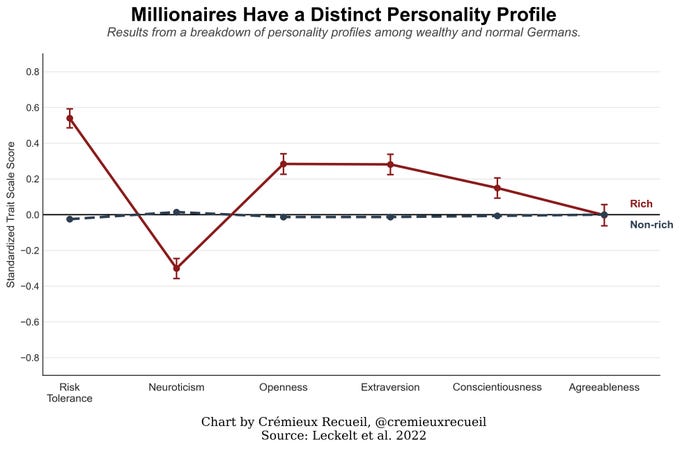
Beyond outliers, there seems to be a small negative correlation between agreeableness and income. My guess is that is because agreeable people are bad at negotiating salaries; a skill that can be learned.
Let me try a different starting point. Pesonality is highly genetic, particularly if you base your studies on peer-reports over self-reports. Agreeableness and disagreeableness correlate with a several different behaviours, some of which are positive, and others which are negative. Ideally, agreeable people would try to embrace the good disagreeable behaviours, and vice versa. They would be mistaken to fight against their natures.
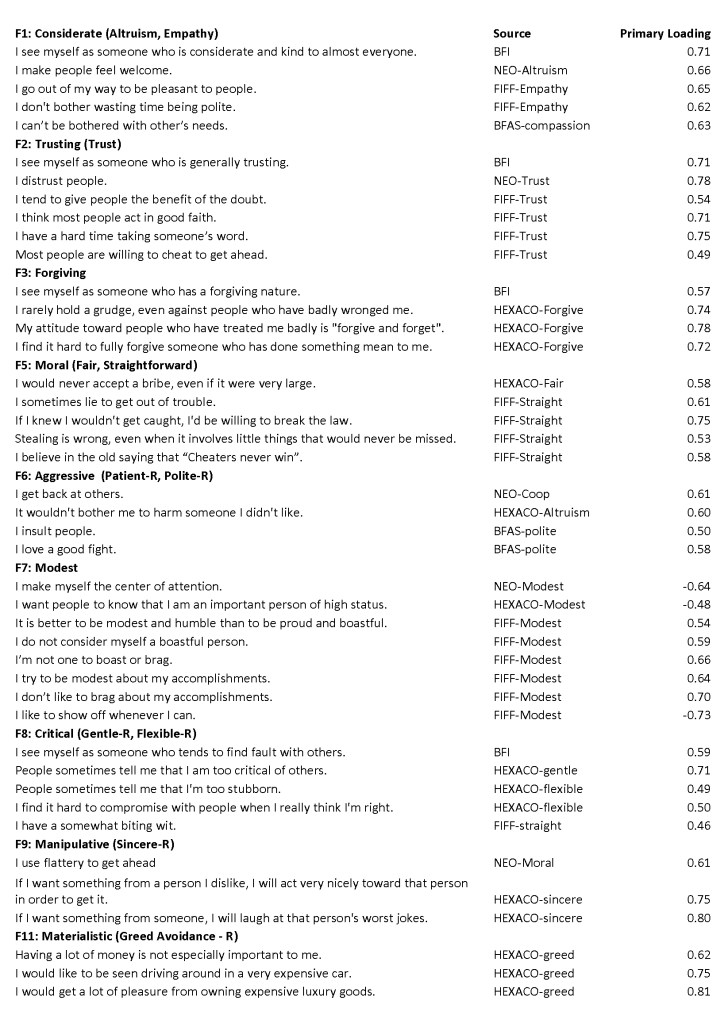
In terms of my own value judgements, this is what I value in disagreeableness: standing up for yourself, contarianism, unashamed selfishness, and groundedness. I appreciate the forgiveness and friendliness in agreeableness. These aren’t contradictory behaviours. Unfortunately, the kind of wiring that produces these behaviours is anti-correlated.
In some cases, there isn’t a right and wrong leaning. It’s difficult to walk the tightrope of being too trusting vs paranoid; or being too full of yourself vs unconfident.
Rather than debate who was born with the best genes, perhaps it would be better to determine what behaviour is and is not valuable to us. That is what I mean when I say that ‘should I be nice’ is the wrong question to ask.
XI.
The optimality of being nice vs mean depends on the situation.
Iterated games reward cooperation. Others don’t. Not very deep.
This complexity encourages people to think that being mean or unrestrained can be “excused” if you are tired, in pain, or undergoing any other personal problem. It’s inevitable, of course, that tired people will say stupid or confused things. They rarely actually start confrontations or drama. They are tired, after all. People who start fights under the influence of drugs might not be starting them off drugs, but they are still choosing to use drugs that make them fight people.
It’s not that phsyiological limits aren’t impactful, or can’t be socially dealt with. What I am arguing against is people who want to be morally excused for behaving in ways that others dislike; things they probably would have done regardless of their own physiological limits. I find it pathetic.
Many amoral people, including myself, do not act nicely out of strategy. There’s an aesthetic to it — there is nothing wrong with kicking a dead dog. It’s just ugly. People have often highlighted that Nietzsche was polite and friendly in real life; it does contrast wito his amoral philosophy, but I wouldn’t say it contradicts it.
IIII.
Some find nice people fake — a bit of a loaded word. Agreeable people will do the thing where they notice things that are off, and not say anything about them. I would consider that to be reticent behaviour, not inauthentic. A lot of nice behaviour is practiced; though it would be a category error to call that fake. Then there is the issue that we can’t see into other people’s souls; a disagreeable person cannot really know whether an agreeable person behaves that way because they are being strategic vs whether they do it because it is innate.
Since agreeableness doesn’t seem to correlate much with real world success, I’m inclined to think most nice people are just “like that”. They don’t get reliably punished or rewarded for what they do, so people who try to be strategically agreeable are likely to quit when they do not get what they want.
Agreeable encounters can be a little anxious. Two people being friendly with each other could be acting on their base instincts, but might be afraid that the friendliness might not be lasting. There’s a certain ambiguity about friendliness that can’t be dissolved by being smart or stable. Hostile encounters are also tense, but in a different, and more intense way. Presumably, people differ in how tense they feel in friendly vs hostile encounters; they might be pleased with agreeableness, but find it streessful. I will say though, that if people didn’t like friendly encounters, they wouldn’t feel anxious about them being fleeting. It’s evident people like friendliness in isolation.
There is a certain type of neurotic who likes being demeaned. They don’t believe they are entitled to anything besides it; a nice person makes them feel too unworthy.
There is another problem — that different personality traits can cause the same behaviour, or one personality trait can. A guy who looks nice might just be anxious or have an overly manufactured personality. People notice this, then blame the niceness.
People have tried to solve this problem with dichotomies: kind vs nice, or empathy vs sympathy, or affective empathy vs cognitive empathy. These can be clarifying in some respects. For example, a person who throws away drugs you are addicted to is being kind, not nice. These dichotomies are still unhelpful, and frame the discussion in terms of morality, rather than value or utility.
On the question of women. Those guys who neg and push women’s boundaries and get laid anyway do exist, but women vary in how they respond to them. I’ve heard stories of men who decided to play the asshole or start negging, and say it worked. Whether what they describe actually occurred, or occurred the way they think it did does not interest me.
What does, is why that would be the case. The obvious answer nobody talks about is novelty. Most guys don’t approach. If they do, they aren’t charming or interesting. A guy who walks up and starts being an asshole is different and memorable. It signals attitude.
It’s easier to be boring if you are being nice. Niceness beats meanness, but vividness beats niceness. For both sexes. This is why women argue about whether they should be nice, when it is obvious that men like nice women; they just like the lively ones more than the nice ones.
The most importance difference which maps onto nice/mean is value generative versus value extractive. Am I adding value or merely moving value. A society of mover dominance disincentivises generation, which leads to poverty. The viscerality to "assholes" in dating is that it implies women merely care about value, not generation at best or at worst appreciate moving over generating.
Rather useless article because it doesn't address the prevalence or ratios of (dis)agreeable-ness in terms of group survival or cultural cohesion. You kind of barely, obliquely address the game theory, but don't go on to talk about selection pressures in a given environment and how equlibria/baselines are set to attract or repel various neurotypes – which, after enough biological iterations, is encoded through pleiotropy and/or polygenetic inheritance.
There's also the question individual psychological tradeoffs for a person placed into an an environment that doesn't math their preferred/habituated approach(es).